Doctoral Focus
Probabilistic Inference using Extended RFS on CMOS and Electro-Optical Data (PIERCED)
Overview
My doctoral focus is split into two main topics: a multi-observer extended-object tracking framework applied to storms observed from low Earth orbit (LEO), and orientation and intent tracking for non-cooperative spacecraft swarms. These problems are approached through random finite set (RFS) frameworks. The fusion components follow generalized covariance intersection or arithmetic averaging, while the intent-tracking portion relies on a specialized model for orientation estimation from point-cloud measurements.
Motivation
LEO satellite constellations are becoming increasingly common because they offer improved spatial resolution for terrestrial monitoring relative to higher orbital regimes, along with favorable communication opportunities. At the same time, this growing population is creating a more congested orbital environment, which increases the need for improved situational awareness. This motivates the two problems studied in this research:
- Storm tracking directly on orbit for broadcasting estimated parameters to ground stations and enabling probabilistic fusion. This supports global tracking of electrically active storms while transmitting compact state information rather than raw sensor data.
- Orientation tracking for improved space domain awareness (SDA), including predictive maneuver assessment and estimation of where spacecraft swarms are pointing. This becomes increasingly important as more constellations are deployed.
Technical Approach
- High-fidelity simulation of satellite orbit propagation, including pointing dynamics and onboard logic.
- Storm simulation using surrogate modeling, with lightning flashes mapped onto an ellipsoidal Earth model to simulate onboard pixel detections.
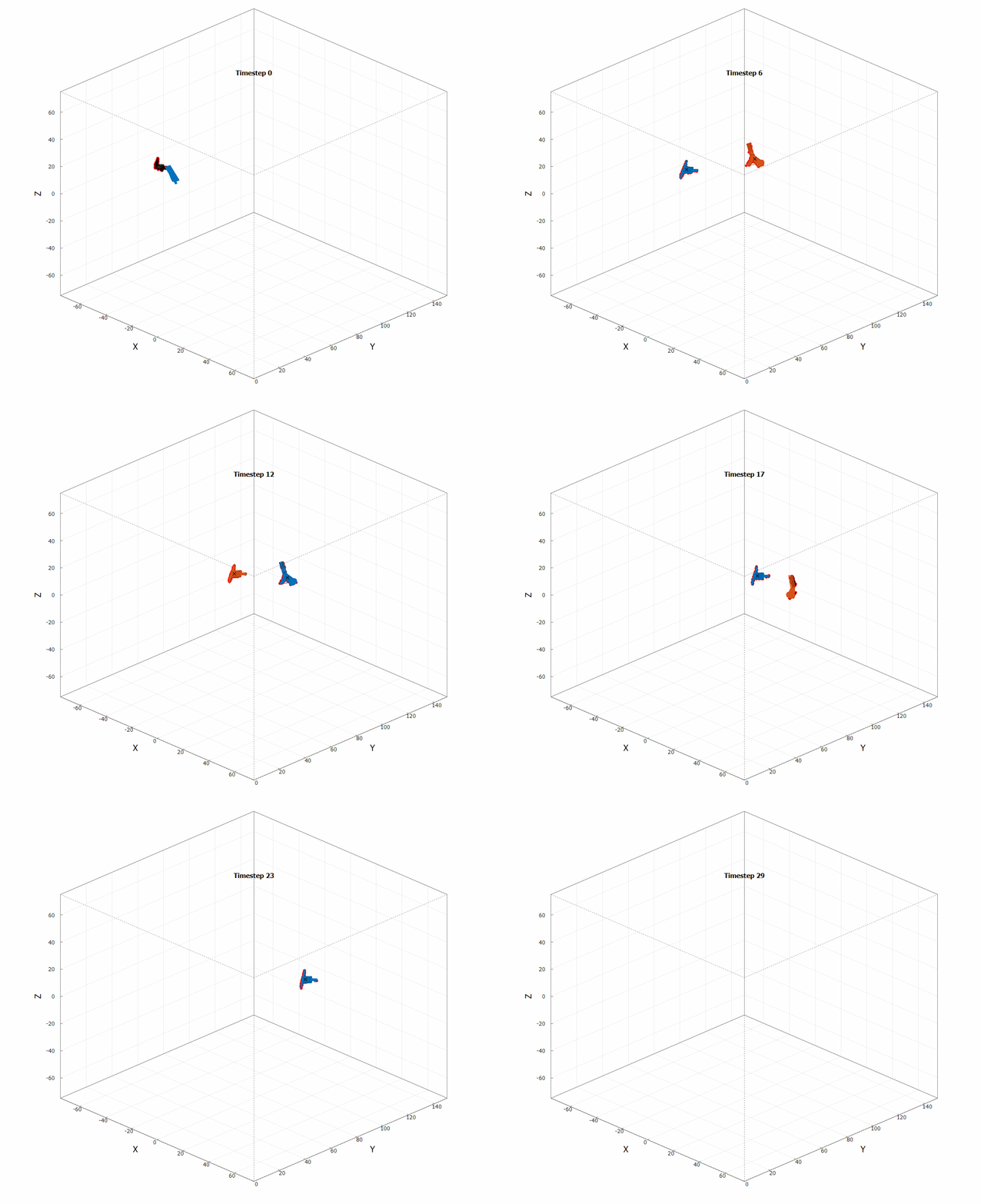
- Development of a new RFS model for tracking orientation in addition to kinematics from point-cloud measurements alone.
- Tracking swarm orientations over time to characterize intent.